Navigating the New Era of Search: Google Marketing Live 2026 Updates for Healthcare & Small Businesses
The digital marketing landscape just shifted beneath our feet. If you are running a local medical practice, a physical therapy clinic, or a growing small business, how people find you online is radically changing.
Yesterday, Google wrapped up its highly anticipated Google Marketing Live 2026 conference. The overarching theme? Agentic AI and Conversational Search. Google is no longer just a list of blue links; it is transforming into an interactive ecosystem powered by Gemini.
For healthcare and small business owners, this means standard SEO tactics aren't enough anymore. You need to optimize for both traditional search engines (SEO) and Artificial Intelligence Optimization (AIO).
Here is a breakdown of what happened yesterday and actionable strategies to ensure your business remains visible, searchable, and recognizable online.

AI technology - Photo credit Tara Winstead from Pexels.
1. Major Highlights from Google Marketing Live 2026
Google unveiled several massive features designed to connect conversational intent with instant action. Three key announcements stand out for small businesses and local services:
Ads in "AI Mode" & Conversational Discovery
Google is leaning heavily into AI Mode—the conversational interface within Search. Instead of static keywords, users are typing complex, specific questions. Google introduced Conversational Discovery Ads and Highlighted Answers.
If a user asks, "I need a low-stress pediatric dentist nearby who specializes in anxious kids," Google’s AI won't just look for the keyword "pediatric dentist." It evaluates and synthesizes information across the web. Highly relevant businesses will appear as a "Highlighted Answer" with an independent AI explainer detailing why your business is the perfect match.
Business Agent for Leads
For service-oriented businesses like medical practices, lawyers, or local contractors, capturing leads just got an upgrade. Google launched the Business Agent for Leads. This agentic AI tool can text or converse with potential clients right inside the ad unit, answering operational questions (e.g., "Do you accept Blue Cross insurance?" or "Is there wheelchair access?") to pre-qualify and lock in high-quality leads before they even click through to your website.
Conversational Attributes & AI Performance Insights
Rolled out via the Merchant Center and local business profiles, Conversational Attributes allow businesses to optimize their data for conversational commerce. Alongside this, a new AI Performance Insights tool maps your business's visual and textual AI search visibility directly against current consumer demand, showing you exactly where you are losing out on local impressions.
2. Shift from SEO to AIO: What It Means For You
Traditional SEO focuses on keywords, backlink counts, and meta tags. AIO (Artificial Intelligence Optimization)focuses on context, authority, and answering highly specific, long-tail questions.
When an AI engine like Google Gemini or an AI Search Brief answers a user's question, it acts like a digital researcher. It crawls the web to synthesize a summary. To be the business that the AI recommends, you must format your digital footprint so an AI can easily ingest and trust your data.
3. Practical AI Tips & Tricks to Maximize Visibility
To make your healthcare practice or small business highly recognizable in this AI-driven era, implement these advanced strategies immediately:
Rule 1: Optimize for Zero-Click Conversions with Conversational FAQ Content
AI models pull text directly from sites that give clear, direct answers to complex human questions.
The Tactic: Stop writing short, generic blogs like "Benefits of Physical Therapy." Instead, build an in-depth FAQ database answering specific long-tail queries.
Example for Healthcare:"Can I do physical therapy if I have a herniated disc, and what should I expect during the first session?" Give a direct, 2-3 sentence summary right at the beginning of the answer so the AI can pull it as a snippet, followed by deeper educational nuance.
Rule 2: Claim and Hyper-Specify Local Attributes
Because Google’s new Business Agent for Leads relies on existing information to speak to customers, your local profiles must be hyper-detailed.
The Tactic: Fill out every hidden attribute in your Google Business Profile. If you run a medical clinic, explicitly list every insurance provider accepted, specific handicap accessibility features, parking details, and exact sub-specialties. If the data isn't structured there, the AI agent cannot communicate it to a prospective patient.
Rule 3: Build "EEAT" that AI Can Verifiably Parse
Google’s search algorithms place immense weight on E-E-A-T (Experience, Expertise, Authoritativeness, Trustworthiness), especially for "Your Money or Your Life" (YMYL) industries like healthcare.
The Tactic: Every medical piece or service page on your site should include an explicit author bio linking to verified medical credentials, NPI numbers, or professional LinkedIn profiles. Use Schema Markup (structured data code) to explicitly tell search engines who wrote the content, what their medical credentials are, and what organization reviews the accuracy of the information.
Rule 4: Audit Your "AI Visibility"
With the rollout of AI Performance Insights, track how often your brand is mentioned or cited in AI summaries. Check your Google Search Console to see if you are gaining impressions from conversational queries rather than just broad local terms.
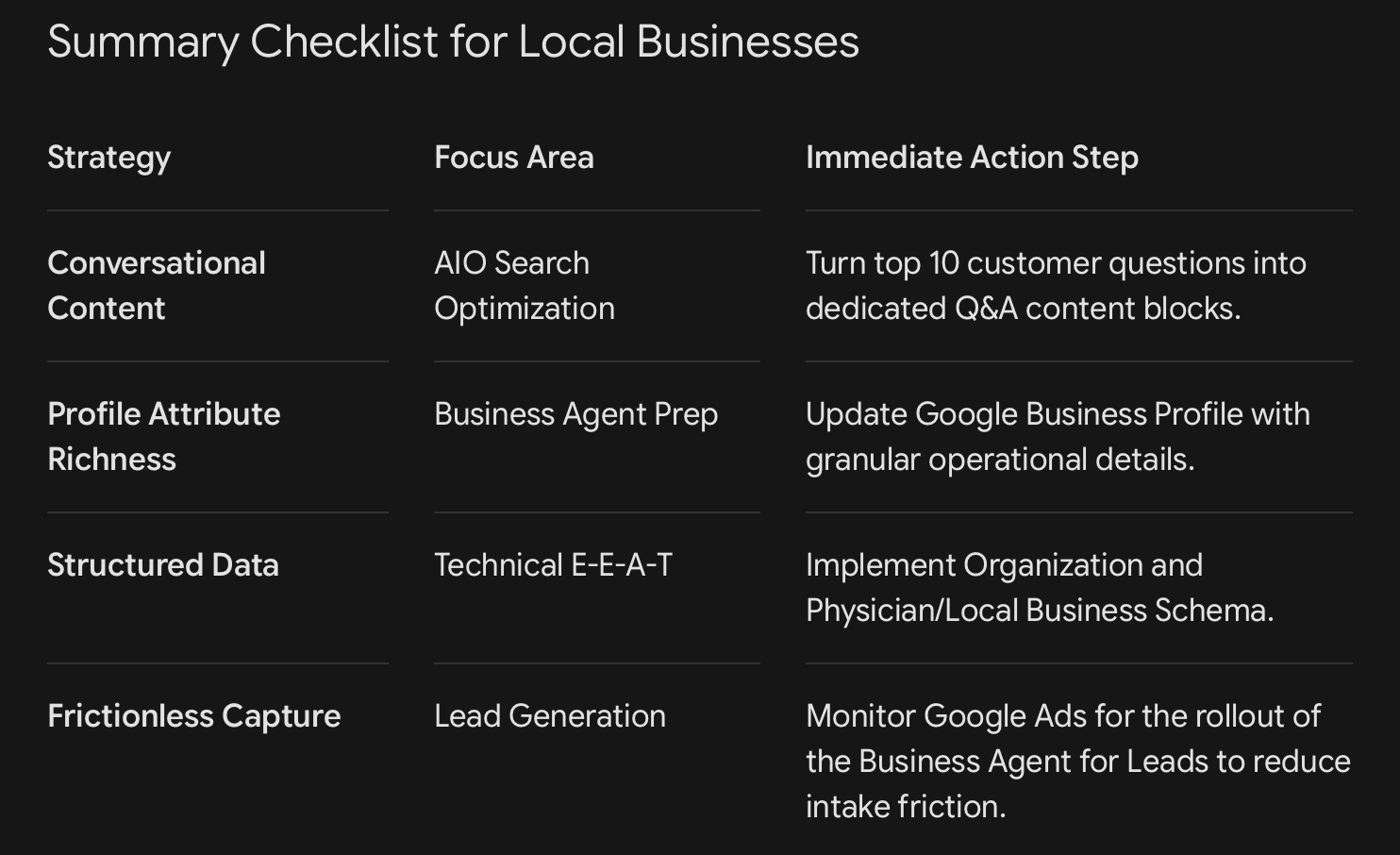
Local Business AIO Checklist
Summary Checklist for Local Businesses
The businesses that thrive in 2026 won't be those trying to trick the algorithm with keyword stuffing. Success lies in making your business data undeniably clear, structured, and authoritative so that Google's AI agents confidently recommend you as the definitive solution to a user's problem. Remember that optimizing your website is an ongoing process and requires a structured process to earn mentions from AI searches.